


The Fact
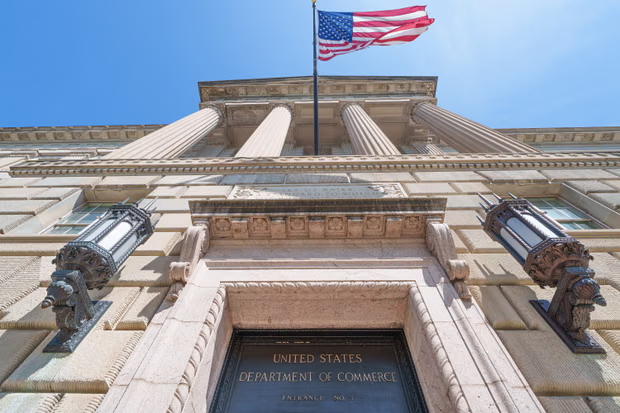
In the first week of May 2026, the U.S. Department of Commerce expanded its agreements with major AI developers, including Google and Microsoft, to review advanced AI systems before they are released to the public.
Through its safety evaluation programs, government teams are now given early access to these models. They test for risks tied to cybersecurity, misuse, and broader national security concerns. This is not advisory guidance from the outside. It is direct involvement in the development pipeline, before the product reaches users.
The shift matters because it changes where decisions are being made. AI systems are no longer moving from company to public in a straight line. There is now a checkpoint in between.
The Risk
That checkpoint looks like an oversight. It also complicates responsibility.
Once a government body reviews a system before release, the line between “builder” and “approver” starts to blur. The companies still design and deploy the models, but those models now pass through a layer of institutional review that carries weight, even if it is not formally called approval.
If something goes wrong after release, the question will not be what the AI did. The question will be who allowed it to be there. And that is where the structure begins to weaken.
The companies can point to the fact that their systems were reviewed under a government-led process. The government can point to the fact that it did not build or deploy the system. Inside, both teams can point to the process itself, the testing, the evaluations, and the framework that was followed.
Each part of the chain has a role. None of them is clearly positioned as the final point of responsibility.
What’s Changing
This is a shift from regulation to participation. For years, governments have tried to control AI from the outside by setting rules after systems are released. That model is now being replaced with something closer to shared involvement. The state is stepping into the development cycle itself, not just reacting to its outcomes.
At the same time, companies are not just building products. They are building products that move through a system that includes government review, which changes how those products are perceived and, potentially, how they are defended.
The process is becoming collective. The accountability structure is not evolving at the same speed.
The Pattern
This is not happening in isolation. Across sectors, especially in areas tied to risk security, finance, and healthcare, AI systems are no longer being deployed by a single actor. They are being introduced through layered relationships such as developers, regulators, partners, and contractors. Each layer adds legitimacy. Each layer also adds distance from the final decision.
What used to be a clear line of responsibility is becoming a network. And networks are harder to hold accountable than individuals.
What This Could Become
If a system that passed through this process causes harm, the response will likely follow the structure that produced it.
The company will explain how the system was tested and reviewed. The government will explain the limits of its role in that review. The process itself will be presented as evidence that due diligence was done.
The failure will still exist. The difficulty will be locating where responsibility settles.
Not because it is absent, but because it has been spread across too many points to land cleanly on one.
Radar Verdict
WHO IS DEPLOYING THE SYSTEM
The U.S. Department of Commerce, working directly with major AI developers
WHAT THE SYSTEM DOES
Reviews and tests AI systems before they are released to the public
WHERE ACCOUNTABILITY IS UNCLEAR
Responsibility between those who build, those who review, and those who approve deployment
RADAR RATING
🧭🧭🧭🧭 (4/5) – The system introduces oversight, but no single actor is clearly responsible when that oversight fails